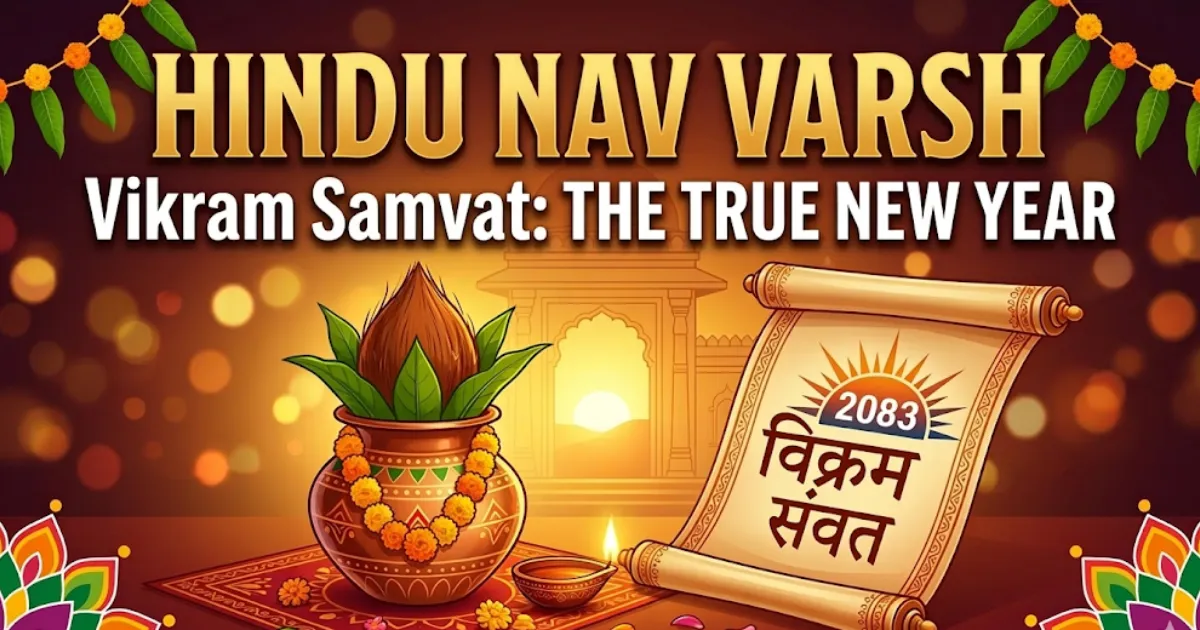
Every civilization measures time in its own unique way. Calendars are not merely systems of counting days; they reflect the culture, philosophy, and worldview of a civilization. In the Hindu tradition, the beginning of the year is not marked on January 1st, but with the arrival of Hindu Nav Varsh, the start of the Vikram Samvat calendar.
Hindu Nav Varsh, celebrated on the first day of the Chaitra month (Chaitra Shukla Pratipada), marks the beginning of the Hindu lunar calendar. It is a day that holds immense spiritual, historical, and cultural significance in Sanatan Dharma. Across India, this day is celebrated in various forms such as Ugadi, Gudi Padwa, Cheti Chand, and Navreh, but the underlying meaning remains the same: the beginning of a new cosmic cycle of time.
Unlike the Gregorian calendar, which is purely solar and globally standardized, the Hindu calendar is deeply rooted in astronomical calculations, seasonal cycles, and Vedic traditions. This makes Hindu Nav Varsh not just a cultural celebration but a scientifically aligned beginning of the year.
Understanding Hindu Nav Varsh helps us rediscover the ancient wisdom of the Hindu civilization, where time itself was considered sacred.
The Vikram Samvat calendar is one of the most ancient and historically significant calendars of India. It is believed to have begun in 57 BCE and is traditionally associated with the legendary king Vikramaditya of Ujjain.
According to historical accounts and traditional narratives, King Vikramaditya established this calendar after defeating foreign invaders and restoring prosperity and order in his kingdom. The calendar was introduced to commemorate this victory and became widely used across the Indian subcontinent.
Unlike the Gregorian calendar, which is now globally used, Vikram Samvat is approximately 56–57 years ahead of the Gregorian year. For example, when the Gregorian calendar shows 2026, the Vikram Samvat calendar shows around 2083.
For centuries, this calendar has been used in Hindu religious rituals, temple traditions, festivals, and astrological calculations. Many Hindu festivals such as Navratri, Diwali, Holi, and Ram Navami are determined according to this calendar.
Thus, Vikram Samvat is not merely a way of counting years; it represents the continuity of Hindu civilizational timekeeping.
One of the most fascinating aspects of Hindu Nav Varsh is that it begins with the arrival of spring.
The month of Chaitra, which marks the start of the Hindu year, falls around March-April, a time when nature itself begins to renew. Trees blossom, crops ripen, and the environment becomes vibrant again after winter.
Ancient Hindu scholars believed that the beginning of a year should align with natural cycles, not arbitrary numerical changes.
According to Hindu scriptures:
The creation of the universe by Lord Brahma is believed to have begun on Chaitra Shukla Pratipada.
The Satya Yuga, the first of the four cosmic ages, is also said to have started on this day.
It marks the start of the Navratri festival, dedicated to Goddess Durga.
This alignment of the calendar with cosmic and natural rhythms shows the deep astronomical knowledge of ancient Hindu sages.
Although the concept of Hindu Nav Varsh is universal in Sanatan Dharma, different regions celebrate it with different names and traditions.
In Maharashtra, the day is celebrated as Gudi Padwa. People raise a Gudi (flag with a decorated pot) outside their homes, symbolizing victory and prosperity.
In South India, it is known as Ugadi, meaning “the beginning of a new age.” Special dishes like Ugadi Pachadi, which contain six tastes, symbolize the different experiences of life.
The Sindhi community celebrates Cheti Chand, marking the birth anniversary of Jhulelal, their revered deity.
Kashmiri Pandits celebrate the new year as Navreh, beginning the day with sacred rituals and prayers.
These diverse celebrations reflect the cultural richness of the Hindu civilization, yet they all originate from the same cosmic calendar.
Hindu Nav Varsh is not just a change of date; it is a spiritual renewal.
In Sanatan Dharma, time is viewed as cyclical rather than linear. Each new year is an opportunity for spiritual growth and inner transformation.
Traditionally, devotees begin the year by:
Performing puja and prayers
Visiting temples
Reading sacred texts such as the Ramayana or Bhagavad Gita
Taking new spiritual resolutions
The day also marks the start of Chaitra Navratri, nine days dedicated to the worship of Goddess Durga. This reinforces the idea that the year should begin with devotion, purity, and positive intentions.
One of the reasons Hindu Nav Varsh is considered the true new year by many scholars is its strong connection with astronomy.
The Hindu calendar is a lunisolar calendar, meaning it takes into account both the moon phases and the solar cycle. This ensures that the calendar stays aligned with the seasons.
Ancient Indian astronomers developed highly accurate systems for calculating time based on:
Lunar phases (Tithis)
Solar transitions (Sankranti)
Constellations (Nakshatras)
This combination ensures that festivals remain connected with agricultural seasons and natural rhythms.
In contrast, the Gregorian calendar is purely solar and was introduced in 1582 by Pope Gregory XIII for administrative purposes.
Thus, the Hindu calendar reflects a much older and more complex understanding of time.
The celebration of January 1 as the new year became widespread during colonial and modern globalization periods.
However, historically and culturally, Hindus have always followed Vikram Samvat or other traditional calendars to determine the beginning of the year.
Unlike January 1, which has no connection with nature or cosmic events, Hindu Nav Varsh is deeply connected with:
The arrival of spring
The beginning of a new lunar cycle
Important spiritual festivals
This is why many scholars and cultural thinkers emphasize rediscovering the importance of Hindu Nav Varsh as the true beginning of the year in the Hindu tradition.
In modern times, as societies become increasingly globalized, there is a growing interest in reconnecting with indigenous traditions and knowledge systems.
Celebrating Hindu Nav Varsh reminds people of:
The scientific achievements of ancient India
The spiritual depth of Sanatan Dharma
The continuity of Hindu civilization
It also encourages younger generations to understand the rich cultural heritage that has been preserved for thousands of years.
Hindu Nav Varsh is far more than a traditional festival; it represents the philosophy of time in Sanatan Dharma.
Rooted in astronomy, nature, and spirituality, the beginning of the year with Vikram Samvat reflects the profound wisdom of ancient Hindu scholars. It reminds us that time is not merely something to measure but something sacred to honor and celebrate.
As the new year begins with Chaitra Shukla Pratipada, it brings with it a message of renewal, prosperity, and spiritual awakening.
By understanding and celebrating Hindu Nav Varsh, we reconnect with the timeless traditions of Hindu civilization and acknowledge why Vikram Samvat truly marks the authentic Hindu New Year.
उत्तरदाता :-
Sachin Verma
Founder HI
प्रश्नकर्ता :-
HI User
.
👁 4402
👁 7784
👁 4008
👁 4368
👁 6703
👁 3530
👁 4455
👁 4211
HinduIntellectual: Explore 700+ shastras, Ramcharitmanas, bhajans, aartis, mantras, festivals, contests, and spiritual insights. A platform for Hindus to connect, learn, and celebrate Sanatan Dharma.
support@hinduintellectual.com